
 Megan Cencula; Courtesy of JINsoonSave this storySave this story
I was 13 when my mom dropped me off for my first manicure at my local New Jersey nail salon, sandwiched between a pizza parlor and a Tiger Schulmann’s. My end-of-the-year eighth grade dance was on the horizon, you see, and I wanted to do something tangible to honor my budding womanhood (or, at least, my entrance into high school). The year was 2010, and the most grown-up nail style I could think of was a French manicure, the same one I saw painted on the hands of both glamorous celebrities and fictional characters, like Jennifer Lopez and Elle Woods. The opaque pink base with a bright white polish slashed across the tips was the epitome of femininity, class, and style—until it wasn’t. But more on that later.
The French manicure, in all of its Y2K glory, was introduced to the world pre-millennium. It was 1976 when Jeff Pink, the founder of Orly, is credited with creating it. He’s told the origin story many times before, and he repeated it to me over the phone this past August in honor of the French manicure’s 50th anniversary.
It goes something like this: In the 1970s, Pink owned a beauty supply store that serviced a number of Hollywood studios. He sold beauty products across categories like hair products, makeup, and of course, nail polish to television and movie sets. One day, a director complained that he was spending too much time changing each actress’ nail colors to match their outfits, and asked if Pink could come up with a style that would go with everything. “In the office, I had a white pencil that women used to use to clean underneath the nail, so that gave me the idea to come up with a white nail polish [tip],” Pink says. “At the time, I couldn't get white nail polish because it didn't exist. I had to fight with [a] company to make me one gallon of white polish, and finally they did.”
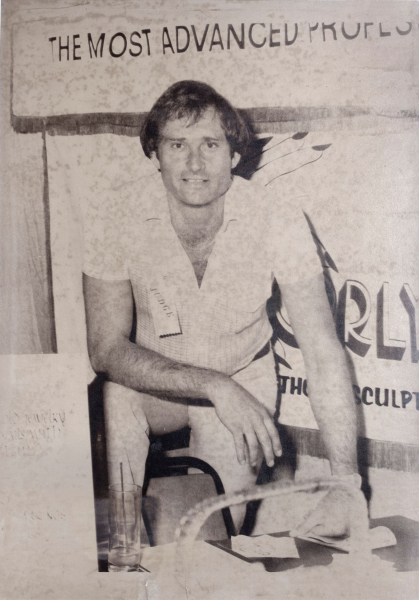
Jeff Pink, founder of Orly and creator of the French manicure, in 1979.
Courtesy of Orly
Pink’s neutral manicure was designed to look like an exaggerated version of the natural nail. Luckily, the director was pleased. “He got so excited and he told me, Jeff, one day you should win an Oscar because you saved the industry so much money,” he says. “I'm still waiting for that.”
In 1976, after his on-screen invention, Pink’s company immediately started producing the style as a kit called the “Natural Nail Look,” et voilà, the French manicure. Although, it would be a few years until it was called the French manicure, and until the look really caught on with the common nail lover.
The turning point came in 1978, when Pink had the opportunity to demonstrate how to achieve his “Natural Nail Look” at Paris Fashion Week, and was suddenly struck with inspiration in the City of Love. “On the way back from Paris to L.A., I said to myself, Jeff, you know what? Natural Nail Look is really kind of cheesy. Maybe you should come up with some other name,” he says. “And then the idea came to me. I just came from Paris. Let's call it French manicure.” And then the French manicure was born.
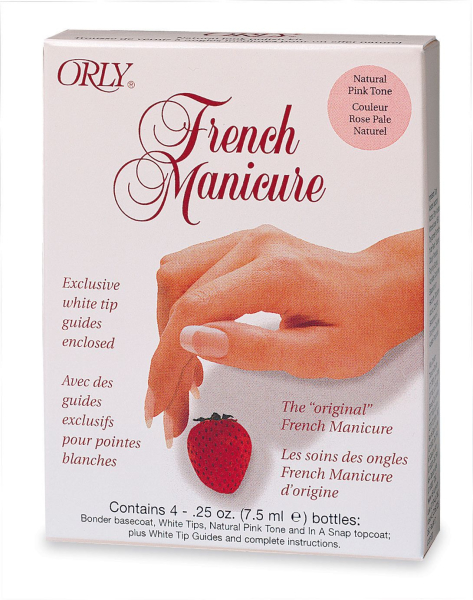
Orly’s “original” French manicure kit.
Courtesy of Orly
“[Orly] was really pushing the versatility component, which was important to women of the 1970s,” says Suzanne E. Shapiro, nail historian and author of Nails: The Story of the Modern Manicure. “It was a look that you could wear from the office to your social life that matched any number of changes of clothing would've been hugely appealing at that era.” The style also gained resonance at the time because “it had that look of Hollywood glamour and the almost aggressive femininity was really appealing,” adds Shapiro. She likens the style to dental veneers for the hands—an artificial, exaggerated version of flawlessness that was trendy at the time.
While Pink may have not gotten an Oscar, he did create one of the most enduring nail styles of all time, so much so that it’s transcended language: Enter any nail salon in the world and you’ll be able to sit down and walk away with the style, communication barrier be damned. (That wasn’t always the case—the manicure style was initially dubbed as an “American thing,” in Europe, but Allure reported in the November 1995 issue that the trend had crossed the pond and become popular among women in France. C’est la vie!) Pink tried to trademark the phrase “French manicure” in 1980, but was blocked—apparently, it was too “well known” for him to be granted ownership of it. Instead, he opted to trademark the phrase “Original French Manicure,” which is still what Orly uses to this day.
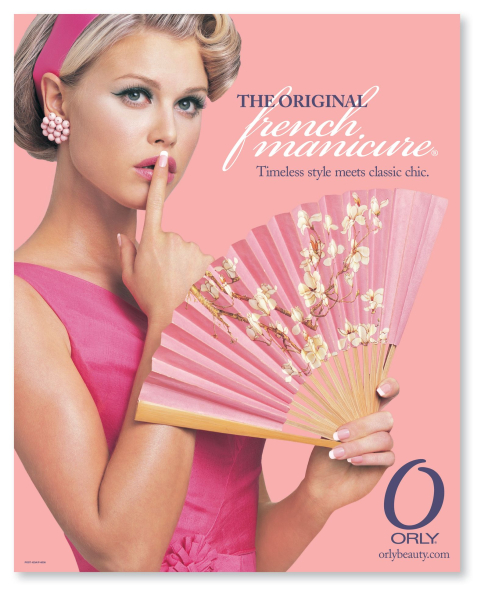
An “Original French Manicure” Orly advertisement.
Courtesy of Orly
What led to the French manicure gaining a permanent spot in the beauty lexicon? Pink believes it was after being seen on the hands of Hollywood starlets and celebrities. He specifically mentions Cher and Barbra Streisand, both of whom allegedly drew attention to their manicures on The Tonight Show With Johnny Carson on two separate occasions. Nail artist Jin Soon Choi, also recalls Streisand and her affinity for the style. She says she remembers it being “glamorous.”
Throughout the 1990s, the white-tipped style soon became synonymous with the nail salon. “My first nail art I did was a French manicure—a classic French manicure—when I was working at a salon in the beginning of the 1990s in New York City,” says Choi. “I thought that was the only nail art that existed. People did either a sheer color, red color, or a French manicure.”
Tom Bachik, a nail artist who’s crafted French manis on celebrities from Jennifer Lopez to Selena Gomez, had a similar experience. “The Nineties was when I started doing nails, so I saw [the French manicure’s] popularity firsthand,” he says. “The bright white tip paired with a pink base was everywhere. It appealed to so many different people because it felt polished and glamorous while still functioning as a neutral.” French tips would go on to be seen on the hands of Jennifer Aniston as Rachel Green in Friends and Elizabeth James in The Parent Trap. Even Princess Diana regularly wore a French mani, both for royal appearances and more casual outings.
Manicurists started experimenting with the style and more intricate nail art when acrylics started to become more popular. “I remember the transition really happening in the 1990s,” Choi says. Women of color in particular were at the forefront of emerging nail trends and used the French manicure as a jumping off point for artistic expression. In the mid-1990s, Bernadette Thompson, celebrity nail artist and founder of Bernadette Thompson nail line, designed a look for rapper Lil’ Kim based on a French design that incorporated a real $100 bill. “She didn't have any opinion on what she wanted to do, but I gave her a French manicure with money on the tips of her nails,” Thompson says. “Lil’ Kim and Mary J. Blige, there was a time when they wanted French manicures. But I told them, "Listen, you ladies are hip-hop artists and you called me. I'm not doing your typical French manicures.” Thompson’s money manicure made history, too—a reproduction is now on display in the Museum of Modern Art in New York City.
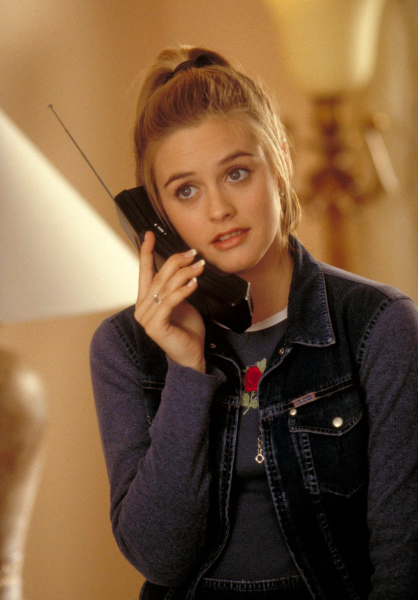
Cher Horowitz sporting a French manicure in the 1995 movie Clueless.
CLUELESS, Alicia Silverstone, 1995, (c) Paramount/courtesy Everett Collection
Acrylics didn’t just allow for decorative nail art designs. They also led to a new version of the classic pink base and white tips. “French manicures had originally been about enhancing the natural nail, but as acrylic nails became more popular, the white tip started becoming wider, brighter, and more of a statement,” remembers Choi. By the late '90s, it was seen on more vivacious characters, like Jennifer Coolidge as Stifler’s mom in American Pie and Elle Woods, Cher Horowitz, and Carmela Soprano. And as we entered Y2K, the look trickled down through salons and ended up on the hands of everyday women—the very same ones who frequented my salons across the country, including my local New Jersey parlor.
As the French manicure’s popularity grew into the late 2000s and early 2010s, something shifted. The ubiquitous style was no longer très chic, but très gauche. “At that point, the French manicure had become closely associated with one specific look, which was a stark white tip with a bright pink base,” Bachik says. “It had become overexposed. Everyone was wearing it. At the same time, beauty trends were shifting toward cleaner, more minimal nails on one end of the spectrum and more expressive nail art on the other.”
Maybe it was the manicure’s permanent placement on mob wife Carmela Soprano’s fingernails, or maybe it was the constant appearance on many a Playboy Bunny's hands (Pamela Anderson and Carmen Electra’s lacquered fingertips come to mind) or its frequent appearance at prom nights across the country. Choi specifically remembers that the cast of The Real Housewives of Orange County—Bravo’s first iteration of its Housewives franchise that premiered in 2006—mostly wore long acrylic nails and “a very extreme square shape” with thick white smile lines across the tips. By the 2000s, that exaggerated version became much more common,” she says. “The same basic French manicure had become a completely different look.”
This, she says, is what really made the style appear “tacky” in some people’s opinion. “[With acrylics] the finish is not as smooth, it's way too thick,” she says. “[People] tried to copy all celebrities that did thick lines." The turn away from deep French manicures also had classist and anti-Black undertones—long acrylic nails and intricate designs had a stigma of being unprofessional when worn on women of color.
Like many era-defining fashion and beauty trends, some age groups didn’t let it go—which also may be the reason why younger generations were quick to dismiss the style as dated and cheap. “There's always a major faction that clings to the style of their youth, and so it starts looking dated,” Shapiro says. “If women of a certain generation are still wearing long, squared-off French manicures, that's probably not going to excite the younger generation and they're going to push back against that.”
At the time, Allure famously did not hold back on its contempt for the style, and a few hot takes have made it on-the-record: A sidebar in the January 2004 issue says a French mani “has about as much style as French’s mustard,” while former Allure beauty features editor Amy Keller called them “cheap” in the April 2005 issue. The article continued that Keller, “like most beauty editors,” kept her nails short and painted with either a pale nude or a dark red shade. A September 2013 Allure story titled “Men On Manicures” quotes an anonymous man who says a French signals that the wearer is “a woman who spends lots and lots of time on herself.” “French manicures were for porn stars, Jersey girls, or bottle blondes with blue eye shadow,” adds David Denicolo, a longtime contributor and former editor-at-large of our print issue. Back in the day, he polled editors on what they thought of the look for a story. “It was just a snapshot of a moment,” he recalls.
“The 2010s were a time when you had to fight to get nail art into the magazine,” Sophia Panych, the staff assistant at the time and now content director, previously said of featuring nail art in the print pages of Allure. But as adorned nails became more popular, the pendulum swung back to accepting the French manicure as a bonafide staple. “It was really the focus on nail decoration, and the idea of nails as an art form, that helped steer the conversation away from it being tacky,” she says.
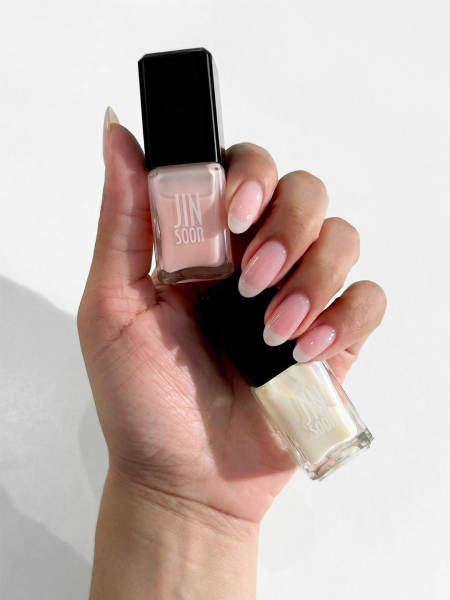
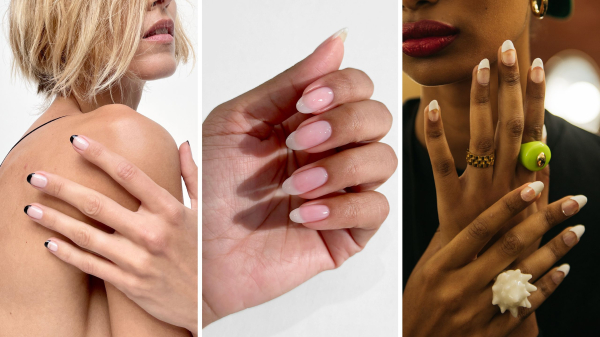
Jin Soon Choi’s “invisible” French manicure.
Courtesy of JINSoon.
Fast-forward to today, there’s been a shift during the last ten years of the French manicure’s life: It’s had a rebirth. Current Allure staffers no longer agree with their predecessors and celebrities can’t get enough of the style. Nail art didn’t suddenly appear after the second millennium (people were adorning their fingers for thousands of years before glazed donut nails were even a whisper of a thought) but as Panych alluded to, the 2010s nail-art boom paved the way for the French tips to take on new life. “Nail art helped people see the French manicure as a framework rather than one fixed look,” Bachik says. “Once artists began changing the colors, proportions, finishes, and textures, it became clear how versatile the style could be. That versatility is ultimately what brought it back.”
“It’s a blank canvas for you to be as creative as you want with a clean baseline,” Thompson adds. “It doesn't have to be clean. It doesn't have to be pure. It could be wild, but it’s still the same concept.”
Choi says she recently created a modern version of the classic style specifically for her client, Zoë Kravitz, that she’s calling the “invisible French.” “She had long nails and wanted an almond shape, and she said, ‘Jin, I want something on my tips,’” the nail artist says. “She's a very natural person, so I put JinSoon Dew on her tips, to make it very clean, and then JinSoon Pixie on top of it.”
So, what’s next for the enduring style? Fifty more years, and then probably 50 more. “There's no comparison,” says Choi. “The French manicure gets the crown all the way.” When asked his prediction, Pink’s outlook is as rosy as the base color for his on-the-fly invention turned beauty phenomenon. “The French manicure is not just a fashion. It's a style, and style lasts forever,” he says. “The French manicure is going to last forever.”