
 Giancarlos KunhardtSave this storySave this story
I wanted to try an unregulated peptide. Over the past six months, I've scrolled countless videos, binged podcasts, and interrogated more peptide-curious people than I can count. I’ve researched all the different versions, from semaglutide to BPC-157, hoping I'd work up the nerve to try one myself—to have the transformation story everyone else claims to be having.
But the caveats kept stacking up: Most of these peptides aren't approved by the Food & Drug Administration (FDA), and the human safety data, where it exists at all, is extremely thin. Health Secretary Robert F. Kennedy Jr. has been pushing for broader access to compounded, injectable peptides, and this summer an FDA advisory committee recommended allowing compounding pharmacies to manufacture six wellness peptides, despite FDA staff—as well as parts of the medical community at large—raising concerns about insufficient evidence around safety and efficacy.
As a beauty editor, I’ve been most tempted by GHK-Cu, a copper peptide that’s become widely known on the internet as the "beauty" peptide. Originally studied for wound healing, research suggests it can support collagen production, improve firmness and elasticity, reduce inflammation and oxidative stress, and aid in skin repair. Hailey Bieber says it’s amazing.
People are already injecting GHK-Cu, even though the FDA has not approved it for injection and has flagged multiple safety concerns with compounded injectable GHK-Cu, including immune reactions related to impurities and peptide aggregation, while noting limited human safety data.
Topical GHK-Cu, however, is another, less risky-sounding story. Non-injectable GHK-Cu is being evaluated by the FDA for use in traditional pharmacy compounding and, for now, falls under the agency's Category 1 interim policy. That means the FDA hasn’t approved the ingredient for use, but also hasn’t (yet!) identified any significant safety risks with non-injectable GHK-Cu and won’t take any legal action against a pharmacy that sells it.
Regardless of the approval status of non-injectable GHK-Cu, copper-infused skin-care creams are (at least for now) considered a cosmetic, not a drug. As long as any company selling them doesn't make medical claims (for instance, they could say that the cream “smooths skin” but not that it “reduces cellulite”) the products wouldn’t be subjected to pre-market safety approval by the FDA. “Any cosmetic product can make claims for their proprietary blends or ingredients with trademarked names without necessarily disclosing the potency of the ingredient or proof of claims,” Nancy Samolitis, MD, a board-certified dermatologist in Los Angeles, says.
I knew I could buy a copper-peptide serum without a prescription, but I was convinced that getting GHK-Cu compounded at a pharmacy meant I would be getting the good stuff: purer, stronger, more potent. I worked with Feelin Good Wellness, a peptide therapy provider that works with physicians and pharmacies to create customized routines based on their health history and bloodwork. The service offers physician oversight, though the doctors I encountered were not dermatologists and appeared to focus primarily on hormone and sexual health. The founder of Feelin Good is Carlyn Mungle, who is not a medical professional but found a path into wellness during the pandemic, when she started a business to help provide COVID testing. A huge fan of peptides herself, Mungle swears by GHK-Cu.“It's a great tool to have in your toolbox," she tells me. "It's good for maintaining healthy skin like you have and supporting healthy aging."
I had also seen enough videos on Instagram and TikTok to convince me that copper peptides were going to change my life, so I filled out a medical intake form, which asks questions about your wellness goals and what peptides you are interested in. Then, I spoke with a nonclinical patient liaison from the Feelin Good Wellness team who is trained in peptide education but is not a nurse or physician. They walked me through what GHK-Cu is and coordinated communication among me, the physician, and the pharmacy. Shortly afterward, a physician approved my prescription, and my 0.5% GHK-Cu cream was on its way. While Feelin Good Wellness advertises this as a moisturizer, I found that it wasn't hydrating enough for my skin on its own, so I treated it more like a serum step and layered a heavier cream on top. The jar was gifted to me for review consideration, but it normally costs $350.
It looked and smelled medicinal—which seemed right? Surely the ugly green pharmacy cream was doing something my pretty little serums weren't.
When I opened the jar, the metallic scent hit my nostrils hard. The cream was a gray-green hue and had none of the sensorial bells and whistles I was used to in skin care at that same price point. It looked and smelled medicinal—which seemed right? Surely the ugly green pharmacy cream was doing something my pretty little serums weren't.
For the next eight weeks, I applied it every day, followed by a moisturizer. My skin is dry and sensitive, and I've never been able to use retinoids with the consistency dermatologists would like me to, but GHK-Cu caused no burning, peeling, or irritation. And after a few weeks of daily use, my skin looked good. Like, really good. I had less redness in my cheeks, my skin looked and felt bouncier, and my complexion looked brighter overall.
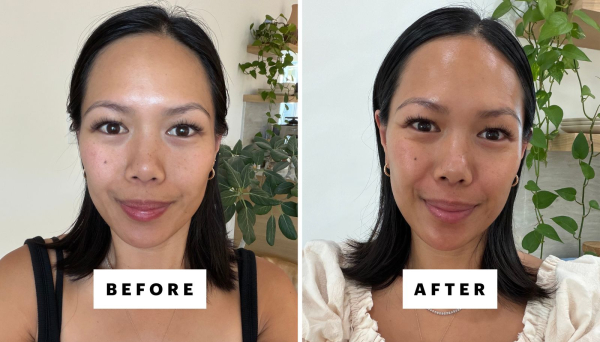 Courtesy subject
I loved the results enough to want to keep using it, but the question was whether it was necessary to spend $350 to keep getting the benefits I was officially convinced GHK-Cu was giving me.
Does GHK-Cu Actually Work in Skin Care?
Dr. Samolitis was curious too. When I told her what I was testing, she went digging through the published research. "I went straight to PubMed for the real data," she says. Dr. Samolitis was pleasantly surprised with what she found.
The human data is limited, but one finding in particular caught Dr. Samolitis's attention. She pointed me to a published review of GHK-Cu research that describes a study of 20 women around age 50 in which researchers applied different creams to the thighs and measured collagen production using skin biopsies. After one month, collagen production increased in 70% of the women treated with GHK-Cu, compared with 50% of those treated with vitamin C and 40% treated with retinoic acid.
"It had a pretty significant increase in collagen production—more than with tretinoin, and more than with vitamin C," says Dr. Samolitis.
Retinoids are considered the gold standard for treating signs of aging, but as I mentioned, my skin often can’t tolerate them. The GHK-Cu cream, on the other hand, caused me no irritation. "I think it's a good retinol alternative," Dr. Samolitis says, though the two work differently—GHK-Cu supports skin repair and collagen production, while retinol accelerates cell turnover and prevents collagen breakdown—and can potentially coexist in a routine.
Still, we’re in the early stages of research on the ingredient, and much of the published studies (like the one mentioned above) have been done by the research and development teams of cosmetic brands who are eager to sell GHK-Cu. “All of the human studies in general with GHK-Cu are small and not randomized controlled trials, so we really need to see more data on this ingredient to accurately describe its benefits,” Dr. Samolitis says. “But it seems to have some promise.” In fact, she was impressed enough by the research that she bought two copper-peptide serums herself. Both were over the counter.
Is Compounded GHK-Cu Better Than Over-the-Counter Copper Peptides?
When I asked Dr. Samolitis if my compounded cream was likely any better than what she had bought, the dermatologist was skeptical. "Honestly, I'm not convinced you need it compounded," Dr. Samolitis says. Neither were the other experts I interviewed.
Compounding means a pharmacy prepares a medication specifically for an individual patient based on a prescription. In the case of GHK-Cu, the pharmacy typically purchases the peptide as a bulk pharmaceutical ingredient and incorporates it into a cream or gel base, explains Ethan Melillo, PharmD, CDOE, a pharmacist and assistant professor of dermatologic pharmacotherapy at the University of Rhode Island.
This type of custom product blend can be useful if you need a particular concentration, can't tolerate a common ingredient, or require a specific base. I didn't have any of those needs. I just thought compounded meant better.
“A compounded prescription does not automatically make a copper-peptide product stronger or more effective.”
"A compounded prescription does not automatically make a copper-peptide product stronger or more effective," Melillo says. The higher price can reflect the medical consultation, pharmacy labor, small-batch preparation, packaging, shipping, and testing—not necessarily a more efficacious ingredient.
In terms of potency, my cream contained 0.5% GHK-Cu. Meanwhile, copper-peptide serums with even higher concentrations are sitting on shelves at Sephora and Ulta Beauty for a fraction of the price. Dr. Samolitis herself bought The Ordinary's Multi-Peptide + Copper Peptides 1% serum, which cost her $32, as well as the Biossance’s Squalane + Copper Peptide Rapid Plumping Serum, which does not disclose its GHK-Cu concentration, for $69. You can also purchase a prescription GHK-Cu serum containing 3% through Musely for $41/month or a 0.5% concentration serum through Agency for $165. It’s still too early for Dr. Samolitis to have noticed any changes in her skin, but she says that she likes the texture of the Ordinary’s serum the most so far.
More Copper Peptide Isn't Necessarily Better
Ultimately, all of those percentages are sort of meaningless in terms of the results you’ll see anyway, at least for where we’re at in copper peptide research right now. Cosmetic chemist Julian Sass, PhD, says we don't have enough clinical data comparing different concentrations of topical GHK-Cu to know exactly where the sweet spot for getting all its purported skin-care benefits lies. "There isn't a ton of clinical data to be able to construct that full dose-response curve well," he says.
Melillo agrees: "We can't definitively say that 0.5% is the minimum effective amount or that 1% will produce better results."
The percentage on the label, it turns out, is almost beside the point. Sass says pH, vehicle, stability, packaging, purity, and delivery all affect how a GHK-Cu formula actually performs on skin. A peptide can sit at the right concentration on paper and still underperform if it's not stable in its base, doesn't penetrate the skin barrier, or degrades in the jar before it ever reaches your face. Commercial cosmetic formulators can build an entire product around solving those problems—encapsulating the peptide to protect it, engineering the delivery system to help it absorb, running stability testing over months—while a compounded cream, made in smaller batches without that same R&D runway, may simply incorporate the raw peptide into an existing base and call it done. Mungle confirms that the pharmacy Feelin Good Wellness works with tests each of the compounded products they create for potency, but does not send it to outside labs for further testing.
"If you're chasing efficacy, a well-formulated skin-care product from a brand that has done testing on the formulation is going to be a much better option [than a compounded version]," Sass says. Melillo seconds this. “One potential advantage of an established skin-care brand is that they may have more standardized manufacturing, supplier qualification, stability testing, and quality-control processes,” he says. Compounding pharmacies source ingredients from bulk suppliers, rather than making them in house, and may rely on those suppliers’ test results rather than doing their own. All compounding pharmacies operating in the United States must be licensed, though that licensing is done at the state level and typically does not include any rules around sourcing and testing practices. “Some may have very thorough supplier qualification, independent testing, and finished-product testing, while others may rely more heavily on the documentation supplied with the raw ingredient,” Melillo says.
Of course, it’s also possible that some of what I saw came from the cream itself, rather than the copper peptide. A base cream can make skin look plumper, smoother, and less red simply by improving hydration. But Sass, who has run controlled studies comparing formulas with and without their active ingredients, says a base moisturizer generally doesn’t produce a significant improvement in collagen production—and any changes in firmness, elasticity, or inflammation tend to be small. “Hydration? Definitely. But not collagen production,” he says.
Dr. Samolitis offers another caveat: Even when studies find a statistically significant increase in collagen under a microscope, that doesn’t necessarily translate to a visible difference in the mirror. She considers copper peptides promising but recommends using them alongside other products for a cumulative effect. In other words, GHK-Cu may have contributed to my results, but without comparing my cream with an identical peptide-free version, there’s no way to know how much credit it deserves.
In other words, I shouldn't have been looking for the most copper peptide in a product. I should have been looking for the best-formulated one—and there wasn't much evidence that mine needed to come from a compounding pharmacy to get there.
"There is not a need to compound something that's available over the counter unless you are also wanting to use a prescription drug with it."
That's not to say compounded skin care doesn't have a place. Dr. Samolitis uses it regularly in her own practice, particularly when it allows her to create something a patient can't otherwise buy. "I do a lot of compounding, but it's only necessary for a drug that requires a prescription like combining tretinoin with hydroquinone," she says. "There is not a need to compound something that's available over the counter unless you are also wanting to use a prescription drug with it."
I personally don’t need that level of customization. Even so, the compounded cream did exactly what I had suspected it would do: It made me a GHK-Cu convert. I just don't think I need a $350 compounded version to stay one.